
Skin Under Pressure
Your skin is not misbehaving. It's filing a report.

The last night of a Las Vegas conference my team hosted annually, we went out with our small army of guests. Dinner that I can only describe as an embarrassment of riches, bottle service on a rooftop, blackjack and roulette until daylight. Most of my colleagues and I were flying home around 11am, which meant loading out of the hotel consisted of throwing down a few plates at the mile-long buffet, brushing teeth, a change of clothes, and doing full arm sweeps of everything into the bag. No shower, no makeup removal. Purely Don’t Miss That Flight Home mode. I felt like death — that specific point where the buzz starts to give way to the hangover — somewhere in the long, winding security line at LAS.
A female colleague, about ten years older than me, passed me as we snaked toward TSA. Bloodshot eyes. Pallid skin. Body language suggesting full-blown nausea. She leaned across the rope and, half-admiringly, half-hissing, asked: “How the hell do you do it? I saw you still at the blackjack table when I went upstairs to pack.”
I didn’t have a protocol. I had a metabolism and the particular impunity of being twenty-something. The skin forgave everything. The math was unfair and I knew it and I didn’t think about it much.
I try that today and my face looks like aggressive Google Earth topography. Detailed. Textured. Zoomed in.
This is not a complaint. It’s useful information.
It means the margin for error has narrowed, which means the protocol has to get sharper. Looking exhausted is not a badge of honor — people clock it before you’ve said a word, and it costs you the first thirty seconds of every room. The goal isn’t perfect skin. It’s skin that isn’t asking the rest of you to compensate for it.
Skin is a presence signal. It reveals hydration, sleep quality, stress load, inflammation, and recovery before you open your mouth. Under pressure — flights, late nights, bad hotel air, event weeks, the particular combination of cortisol and canapés that constitutes a conference — the question isn’t how to achieve a glow. It’s how to prevent the system from broadcasting distress.
The answer, almost always, is fewer inputs. Not more.
What pressure actually does
Most travel skin problems are not product problems. They’re environment problems, which means adding more products is usually exactly the wrong response.
Dry cabin air pulls moisture from the skin for the duration of the flight. Sleep deprivation slows cellular repair and increases dullness. Cortisol — which spikes with travel stress, schedule pressure, and the specific anxiety of performing well in important rooms — increases inflammation and reactivity. Hotel HVAC runs all night directly at your face. And if you’ve been wearing event makeup for twelve hours and cleansed aggressively afterward, the barrier is compromised before the next day has even started.
The skin isn’t misbehaving. It’s reporting conditions. Which means the protocol is about de-escalation.
The flight protocol
Before the flight: moisturize and seal. Keep makeup minimal if you’re wearing any — a compromised barrier plus recycled air plus six hours is not the combination you want arriving at baggage claim. Something occlusive if the flight is long — occlusive meaning a balm or barrier cream that seals hydration in rather than adding more. Mine is a raw shea butter-based balm I make myself, but that’s a rabbit hole for another day. Lip balm. Eye drops if you use them.
During: water, consistently. Hands off your face. Don’t over-cleanse mid-flight. You’re trying to land intact, not achieve anything.
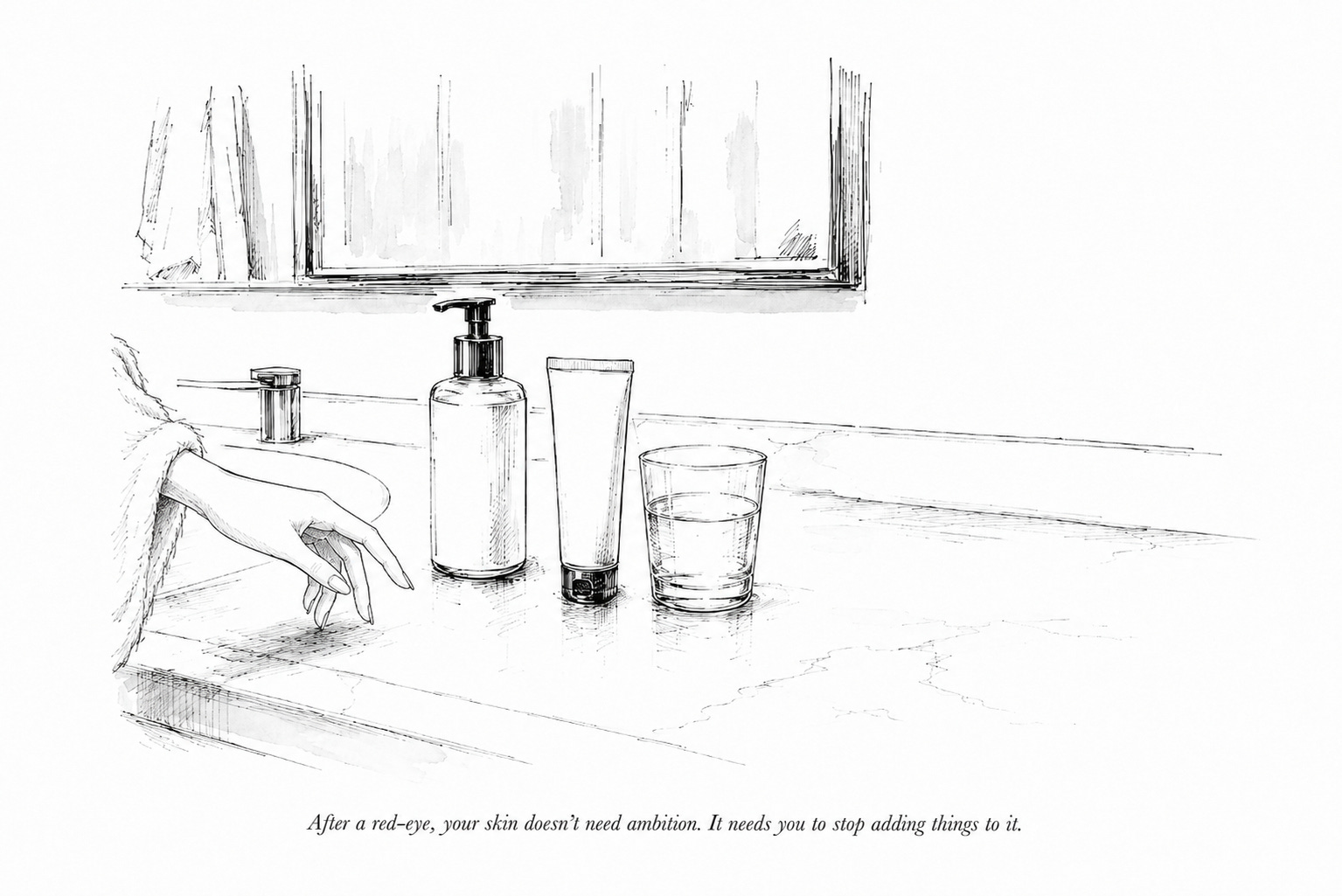
After: your skin doesn’t need ambition. It needs you to stop adding things to it. Gentle cleanse, hydrating layer, moisturizer, seal. Save the actives for when your skin has had twenty-four hours to recover from the assault of getting there.
The hotel protocol
Assume the environment is hostile until proven otherwise. The air is dry. The water is different. The lighting will lie to you.
The first rule of hotel skincare: do not diagnose your face under bathroom lighting after 11pm. Whatever you see is not actionable. It is a function of the lighting, the hour, and the particular cruelty of mirrors in rooms you don’t know yet. Push the magnifying side of the mirror away and go to sleep.
Keep the routine short and familiar. This isn’t the week to try the new serum. Your skin under pressure responds to known quantities. Introduce nothing new. Bring nothing you haven’t already tested at home in calmer conditions.
One thing worth having in the kit: a red light device if the trip warrants it and luggage allows. Red and near-infrared light supports circulation, reduces inflammation, and accelerates overnight recovery — no product, no expertise, ten minutes. Low-drama, high-upside, asks nothing of your barrier.
The event-day protocol
The morning of a big day is for execution, not experimentation. Whatever you’re considering trying for the first time — the answer is a hard no. This is how we end up negotiating with a red cheek at 7:42am like the outcome is still uncertain.
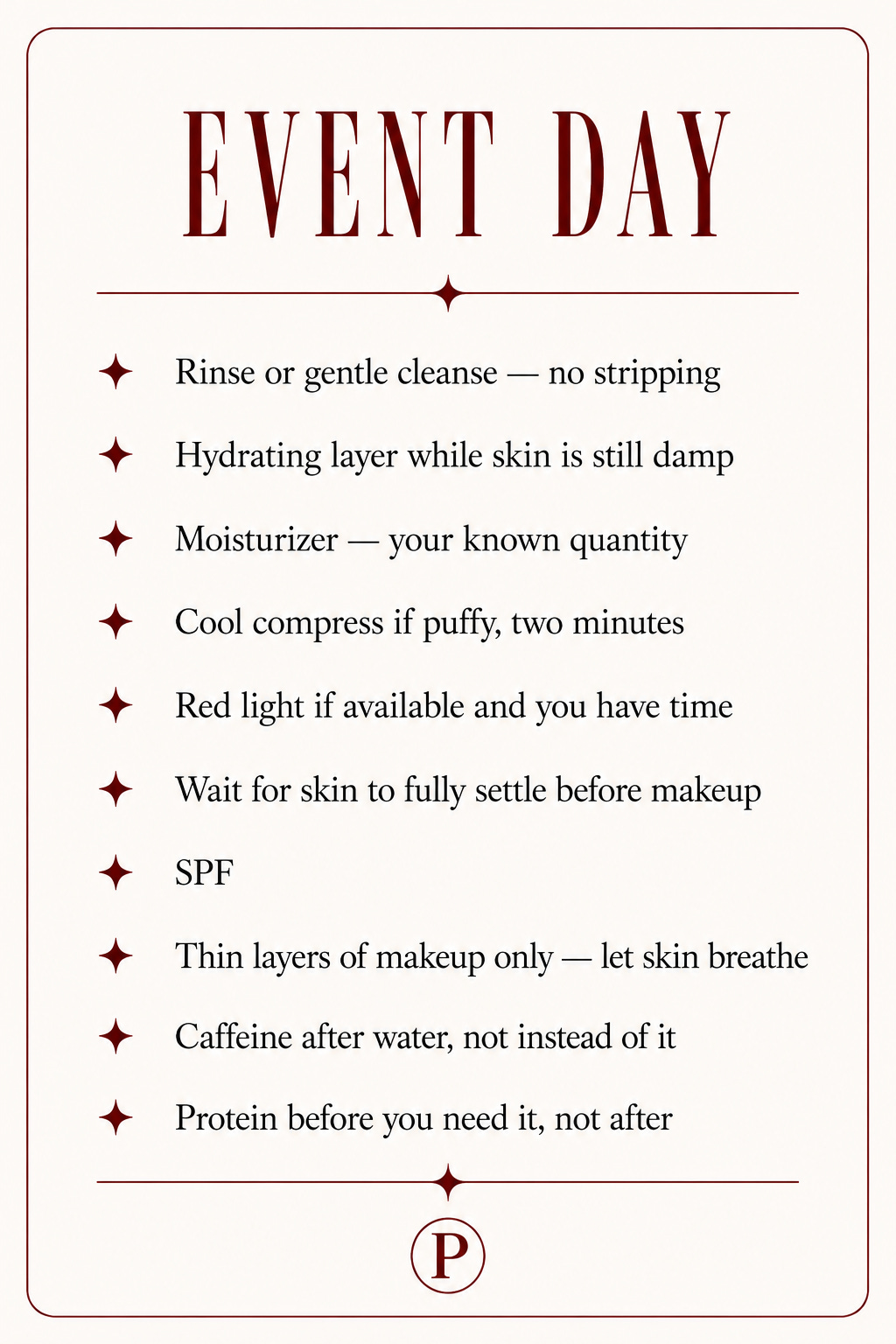
The principle is circulation without inflammation. A brisk walk before getting ready brings color back without triggering reactivity. Cool water after the shower does more than most morning serums. Arrive at the mirror with calm skin that has had time to settle — not skin you’re still negotiating with when the car arrives.
When something goes wrong
It will, occasionally. The move is always the same: de-escalate, don’t attack.
If you’re puffy, it’s usually fluid — address it with water, electrolytes, cool compress, and movement, not product. If you’re tight and dry, hydrate and seal; no exfoliation, no clay, nothing clarifying. If you’re red and reactive, stop actives entirely and reduce friction. If you’re breaking out, spot treat with a known product, conceal lightly, and leave it alone. The impulse to fix aggressively is understandable and almost always wrong.
The morning of a big day is not the time to declare war on your face. It’s the time to give it the least amount of input required to show up calm.
The minimum viable glow
When the system is stressed, the kit gets smaller, not bigger. Clean skin. Hydrating layer. Moisturizer you trust. Occlusive seal if the air is dry. SPF. Concealer if needed, applied lightly. Cream blush on the high points. Lip color that reads as awake. Done.
Glow is not a product. It’s a condition — what happens when hydration, circulation, sleep, and calm briefly agree to cooperate. Under pressure, you’re not manufacturing it. You’re creating the conditions for it.
What to stop doing when skin is stressed
Stop exfoliating because you look dull — dullness after travel is usually dehydration, not dead skin. Stop trying the new mask because you feel desperate — desperation is not a skincare philosophy. Stop over-cleansing because you feel greasy — the grease is often the barrier compensating for being stripped. Stop touching your face in airports and conference rooms. Stop evaluating your skin under hotel bathroom lighting after 11pm. Whatever you see is not real. Just go to sleep.
Most of what happens to skin under pressure is the body doing exactly what bodies do when they’re tired, dehydrated, and running on cortisol and conference food. The protocol isn’t about fixing that with better ingredients. It’s about reducing the variables long enough for the system to catch up.
Twenty-something me didn’t need any of this. The colleague in the security line at LAS did. (No shade.) So do most of us — the ones the room is still watching, who can’t afford to let the night before show all over their face.
— Mel
When skin is stressed, the move is never more. It’s less, done well.