
How to Answer a Hard Question
The answer matters less than how you got there.

There’s a particular kind of question that arrives before you’re ready for it. Not because you didn’t prepare. Because the premise underneath it has shifted while you weren’t looking. You thought you were answering one thing. Then you realize you’re answering for a fact pattern you didn’t create, a decision you didn’t make, and a version of the story that stopped being clean several steps before it reached you.
People don’t remember whether you had a perfect answer. They remember whether you went looking for the nearest exit, reached for a line that had clearly been laminated by someone else, or took the beat required to answer like a person whose credibility still belonged to her.
That beat — the pause before the answer — is doing more work than people give it credit for. It’s the sound of someone thinking before speaking, which is rarer than it should be and noticed every time.
What the wrong answer actually costs
I was running marketing communications at the time, in a sector my company was beginning to take seriously. One of our executives had said, publicly, that he held a particular asset — right as that asset began having its moment in the press. Then it exploded in value. Dramatically. The press wanted commentary.
I got on a call with fellow execs to find out what we’d be telling them. That’s when I learned he’d never actually held it.
Then came the call where I actually had to field the questions. Two men on the line with me, in unison, nearly shouting: “HE SOLD IT?!” Not directed at me in particular. Just the sound of several careers briefly flashing before several pairs of eyes, followed immediately by the room deciding that was, in fact, the line. I sold it a while ago. Five words. Technically airtight. Strategically, a disaster, because the room had quietly shifted what it was actually asking. Nobody cared about the asset anymore.
We weren't protecting the story anymore. We were spending the company's credibility to protect his.
I used the line. I was furious about it — furious the original statement had ever been made, furious the fix on offer was just a different shape of the same problem, furious that I was the one standing in front of the media holding someone else’s bad decision like it was mine.
The fallout arrived exactly on schedule: ridicule, theories that the executive had been chasing the money rather than believing in the sector, a general sense that the company’s commitment was thinner than its talking points. The lie hadn’t covered anything. It had confirmed exactly what everyone already suspected.
What I’d do differently now: not use the line. The available honest answer in that moment — we don’t have a comment on that yet — would have cost considerably less than the version we actually gave. A non-answer reads as discipline. A false answer, once it unravels, reads as character.
The actual distinction
People conflate three separate obligations: answering honestly, answering completely, and answering immediately.
You don’t owe the room the complete answer. You almost never owe it the immediate one. You owe it the honest one. In practice, that means saying the truest thing available to you, clearly, without dressing it up as the whole truth when it isn’t.
The genuinely difficult question
Some questions arrive with real substance and no hidden agenda — they’re just hard, the way actual problems are hard. The mistake here is reaching for a talking point, because a room can always feel when a serious question is being handled with brochure language. The temperature drops immediately.
Name the difficulty out loud before answering it: there’s a real tension there or I wouldn’t pretend that’s fully solved. Then commit to the most honest, stable position you actually hold — not the most impressive one, the most defensible one. A room doesn’t require you to know everything. It requires you to not be performing knowledge you don’t have, which is a much easier and much rarer thing to deliver.
The trap question
This is the one built so any answer becomes a weapon — a false binary, a loaded premise, a question phrased as “yes or no” where neither yes nor no is true. The instinct under pressure is to answer fast, because silence feels like losing. That instinct is backward.
The trap rewards speed. So don’t give it any. Slow your pace, name the terms you’re actually being asked about, and decline the binary outright: I wouldn’t reduce it to either/or or before I answer, I want to be precise about what we’re actually discussing. Someone built a box for you to answer from inside. You’re allowed to simply not get in it.
When you genuinely don’t know
There’s an honest answer available almost any time you’re tempted toward a fabricated one, and it’s usually some version of “I don’t know yet.” That sentence has a bad reputation it doesn’t deserve. The fabricated answer, delivered with total confidence, is the one that actually does damage — because confidence is the one thing a fabrication can fake convincingly, right up until it can’t.
I don’t know, and I’d rather not guess costs you a moment of looking less prepared. Here’s what I know, here’s what I don’t, here’s what I’d need to confirm costs you nothing at all and tends to read, correctly, as the most credible person in the room. Treating the truth as the deliverable instead of the performance is a small move that does enormous, compounding work over time — ask anyone who’s had to watch a confident lie unravel slowly, in public, over several news cycles.
Redirecting without deflecting
A redirect curdles into deflection the moment it refuses to engage what the question was actually asking. The difference is audible. That’s not really the issue, what matters is... is deflection in a blazer. The concern underneath that is real — I’d answer it this way respects the question enough to take it seriously while still steering it somewhere useful.
You don’t have to answer the exact question as posed. You have to answer the honest version of it — which is sometimes the better question the person was circling without quite landing on.
Buying a beat
My method: stop the rush physically before doing anything else. Feet grounded. Shoulders down. One real breath. Then name the frame, not the answer.
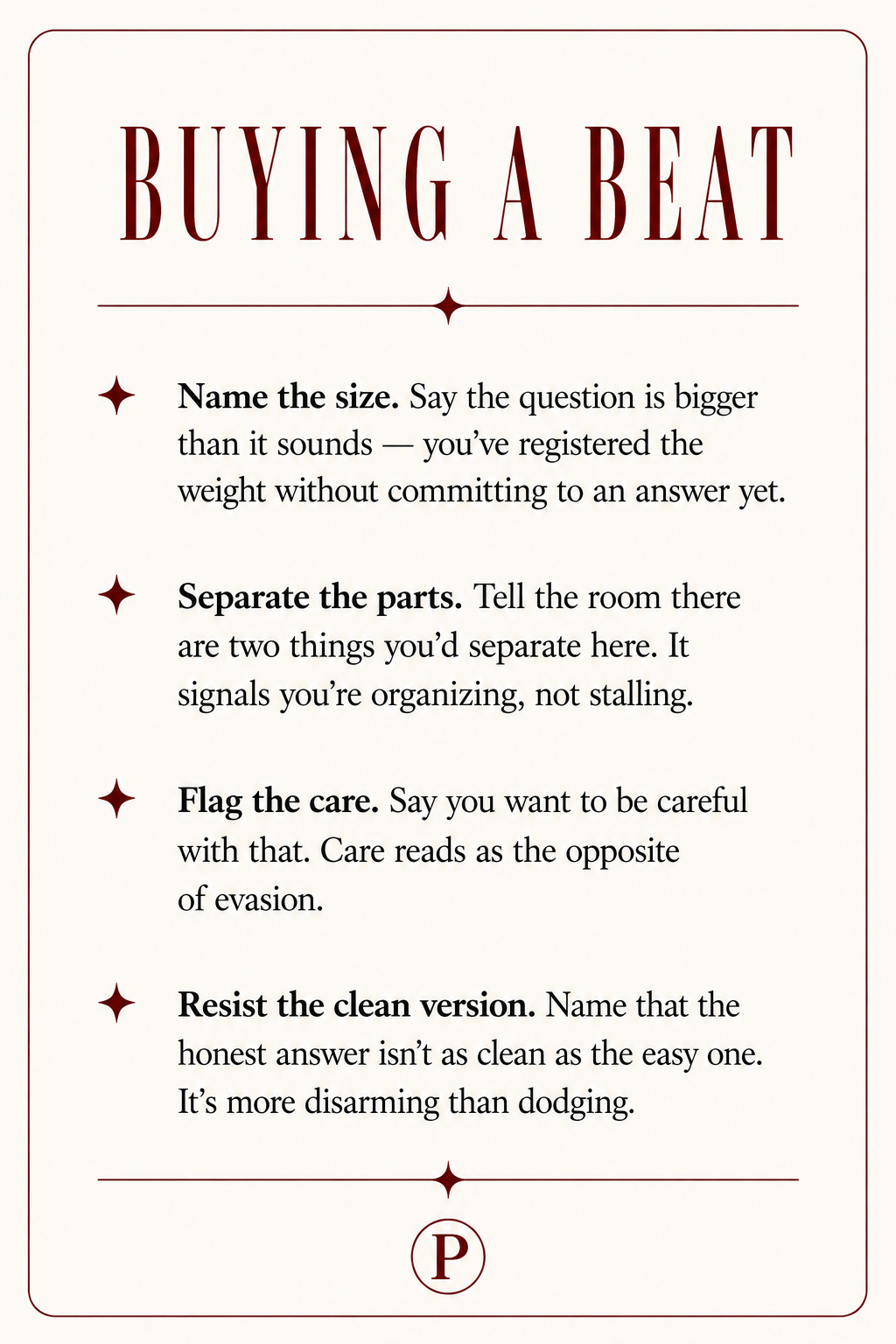
These sentences buy time without sounding like stalling, because they’re doing actual work while they’re being said. The room hears someone sorting, not someone panicking. That distinction is audible within the first three words, long before the real answer arrives.
A hard question is a rare, unscheduled look at someone’s actual operating system. The room doesn’t need frictionless. It needs to trust that friction won’t make you false.
— Mel
Credibility is spent in sentences. Spend yours carefully.