
Media Interviews
The interview starts before the camera does.

A friend asked me to stop by for a chat. He’s a journalist — someone I’d known long enough that the idea of it being anything other than a casual catch-up didn’t fully register. What I hadn’t accounted for: sixty thousand flight miles across the previous two and a half weeks, the jetlag of a time zone I’d just landed in, and six pm local time coinciding almost exactly with what my body had quietly decided was three in the morning.
I had been awake and working for fifteen hours. I was, to use the technical term, a walking billboard for autopilot.
I didn’t ask what the topic was. Why would I? I knew him. The camera started rolling, he gave me the floor, and my mind went blanker than a brand new chalkboard. I sat there with fifteen hours of accumulated nothing where my thoughts should have been, trying to locate a single usable sentence on a subject I’d spent months drafting positions on. The jetlag had apparently filed all of it somewhere I couldn’t access.
Low stakes. Thankfully, emphatically, low stakes. A live hit would have been a different story with a considerably less pleasant ending. As it was, I got some iconic stills out of the location and a firsthand understanding of something I’d only ever understood theoretically: the preparation isn’t knowing the topic. The preparation is arriving in the room with something specific and formed and ready, regardless of how well you know the material and how comfortable you are with the person asking.
A media interview isn’t a conversation. Conversations are improvised. Interviews have rules, and knowing them before you sit down is the only real preparation.
The mindset shift
The standard advice before any media appearance is some version of “relax, it’s just a conversation.” This is correct in the way that “just breathe” is correct during a difficult meeting. Technically true, practically useless.
The actual shift is this: walk in with a committed opinion, not a position to defend. Conversational ease is a byproduct of conviction — when you know exactly what you think and can say it in a sentence, the interview relaxes around you rather than requiring you to relax into it. The journalist’s questions become vehicles for your point of view rather than obstacles to navigate.
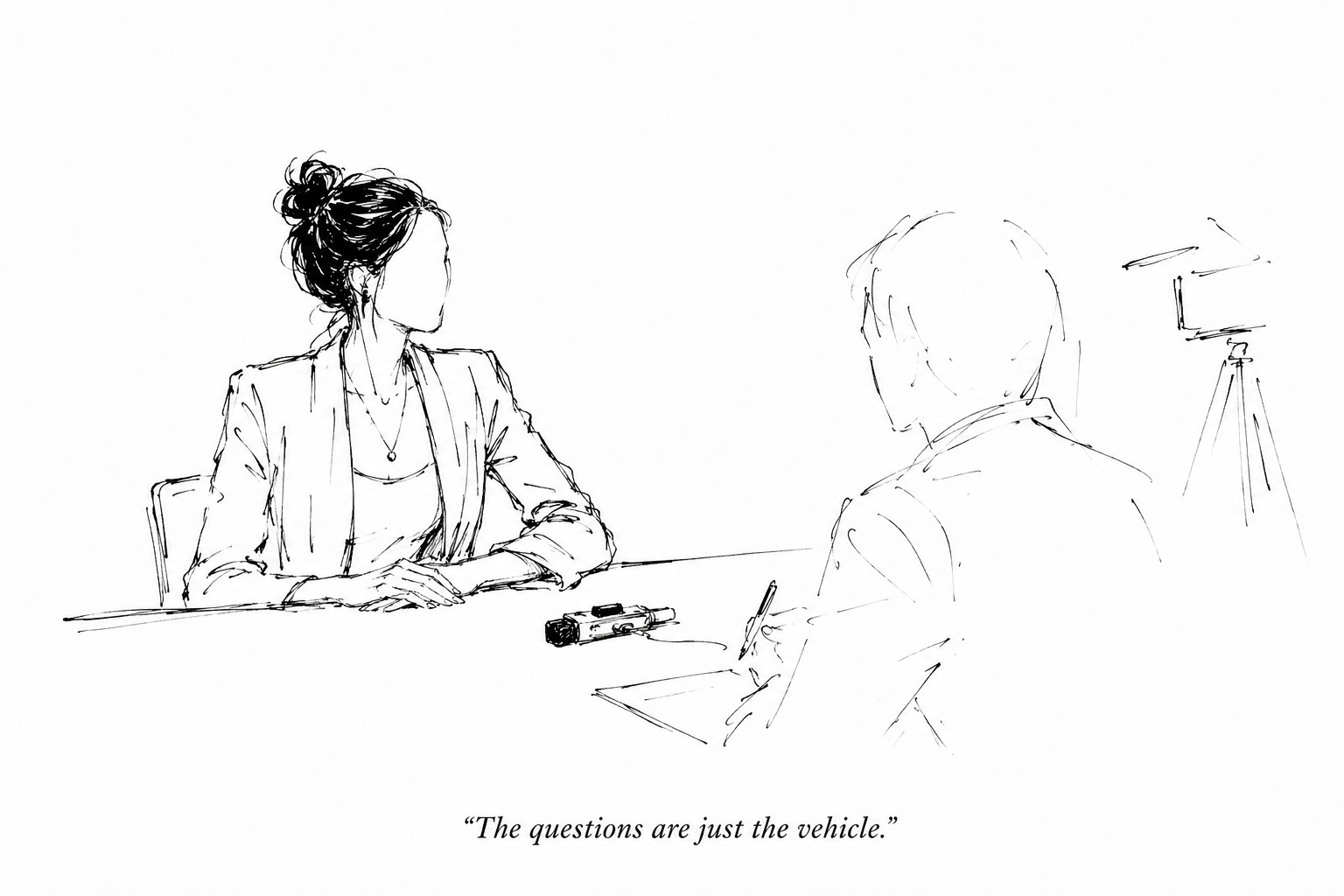
You’re not there to answer questions. You’re there to deliver a message. The questions are just the vehicle.
What to wear
For camera: solids over patterns, always. Busy patterns distort on screen in a way that becomes the story instead of you. Blue reads well; bright white blows out under studio lighting; red can strobe. Avoid dangly or reflective jewelry — it moves with every gesture and competes with the mic. A jacket also gives the crew an easy place to clip a microphone, which is a practical consideration people forget until someone’s fishing around under their blazer on camera. Dress at the formality level that matches your actual register, not at what you imagine “TV” requires. Dressing up to a costume version of yourself is detectable.
For radio: wardrobe is irrelevant, posture isn’t. How you hold yourself in a chair affects how your voice sounds, which is the only thing the audience gets. Sit up. Find a quiet room. The microphone catches everything, including the HVAC unit, the printer down the hall, and whatever was happening outside the window when you decided to do this from your home office.
For print: unless there’s a photographer, clothing doesn’t factor in. If there is a photographer, treat it like camera.
The preparation framework
The standard advice is three points. The logic is sensible enough: if something gets cut, something survives. Develop three key messages, each short enough to say in fifteen to thirty seconds, and you’ve built insurance against an interview that doesn’t go where you planned.
The problem with insurance is that it’s designed for failure. Three co-equal messages also means that most audiences walk away with one — and not necessarily the one you wanted. Audiences don’t retain multiple competing points from a single interview. They retain an impression.
The question worth asking before any interview is: what’s the one thing I want someone to walk away with? One thing, specific enough to be disagreed with, concrete enough to be quoted, true enough to stand behind without a prepared defense. A thesis built around a specific, named claim beats an insurance policy built around three safe generalities. Specificity is what makes something quotable and credible simultaneously.
Find that line before you walk in. Know it well enough that you can say it plainly at any point in the conversation, without it sounding like you’ve been waiting to say it.
On camera
Hold eye contact with the interviewer. Small glances away get amplified on screen and read as nervous or evasive, even when they’re neither. In person, a brief look to the side reads as thinking. On camera it reads as something you’d rather not say. The frame eliminates the ambient context that would make the same gesture innocuous in a room.
Slow down. Filler words exist because silence feels dangerous. On camera, the pause reads as composure — it also gives editors clean points to cut a soundbite, which means pausing strategically is doing double work. Let the thought arrive before the sentence does.
Keep hands visible but not busy. One deliberate gesture makes a point. Continuous hand movement makes the shot hard to watch. Useful for emphasis, distracting in excess.
Small habits invisible in person get amplified by the frame. A flat resting expression reads as disengaged. A sideways glance reads as uncertain. The camera doesn’t add what isn’t there — it magnifies what is, including the things you don’t know are there. This is especially true when a second camera is running or a live feed is open and you’ve decided that moment is a good time to check your phone.
Staying on message
The standard technique is called bridging — acknowledge the question briefly, then redirect to your prepared message regardless of what was actually asked. Journalists know this move inside out. Audiences know it too, even if they can’t name it. The moment a reporter detects a scripted answer, they probe harder, because something rehearsed is usually obscuring something real.
The alternative isn’t going wherever the question leads. It’s building the answer around a genuine thesis and letting the question be the entry point.
Use concrete, specific, named claims. Safe generalities sound like something to say. Specific claims sound like something you actually believe. There’s a detectable difference, and the camera catches it. A spokesperson with clear, well-sourced points becomes the source who gets called back; a vague one creates more work than they’re worth.
State the uncomfortable fact plainly. The plain version is usually shorter and reads as more honest than the polished one. When something is genuinely hard to say, saying it directly tends to go better than finding a more elegant way to avoid saying it.
Give short answers to short questions. The instinct under pressure is to expand, because more words feel like more control. They aren’t.
When declining to address something, frame it as a personal conviction rather than a policy. “I don’t discuss that” reads as institutional. “I’ve made a decision not to go there” reads as deliberate. Personal conviction is harder to push against than policy, because you’re not debating a rule — you’re up against a stated belief. Harder to argue with. Harder to probe.
Never repeat a negative frame. Not even to deny it. If the question contains a premise you disagree with, don’t repeat the premise while disagreeing with it. “I wouldn’t say I failed at that” still says “I failed at that.” The frame lands first. Correct the premise, state your actual position, move on. The journalist can write the question. You don’t need to write it for them by including it in your answer.
The one thing you should never say
No comment.
Not because it’s impolite, though it is. Because it reads as confirmation. The journalist writes around it, the audience reads into it, and “declined to comment” in a published piece carries exactly the same implication as a direct admission — sometimes more, since the imagination is rarely kinder than the truth.
The honest alternative is almost always available: “I don’t have enough information to speak to that right now.” “That’s not something I’m in a position to address.” “I’d want to get back to you on that rather than guess.” These are refusals. They’re also answers. There’s a meaningful difference, and anyone reading the piece will feel it.
The broader version of this: never reach for a safe generality when a specific, true claim is available. “We’re committed to excellence” says nothing and reads like nothing. “We reduced response time by thirty percent last quarter” says something. One of these is worth quoting. The other is what a journalist skips past on the way to the quote.
Recovering from a bad answer
It happens. The wrong word, the incomplete thought, the sentence that made sense inside your head and arrived in the room as something else entirely.
The instinct is to repair it at length — cushion the walk-back with qualifications, explain what you meant, apologize for the confusion. This almost always makes it worse. The original mistake had one problem. The extended recovery has two: the original mistake, and now the visible recovery from it.
Pause. Correct the specific point. Move forward. “Actually, let me be more precise — what I mean is X.” One sentence. Done. The shorter the correction, the more confident it reads. Losing composure over a misstatement is usually more noticeable than the misstatement itself was.
If you catch a factual error after the interview has ended, call the reporter directly and correct the record the same way you’d add something you forgot to mention. Don’t wait. Don’t email if you can call. The window between an interview and publication is the only one that exists, and it closes.
— Mel
Walk in knowing what you think. The rest is just answering questions.