
Presence Under Pressure
The difference between looking polished and showing up well.

There’s nothing wrong with looking polished. Polish is useful. It buys you the first few seconds — the read across the room, the initial credibility, the sense that you’ve thought about how you’d be seen. Those seconds matter. Don’t let anyone tell you they don’t.
But the mistake is thinking those first few seconds are the whole game.
I was at a panel once where you could’ve ranked the speakers before anyone opened their mouth. The visual hierarchy was obvious: clothes, posture, the particular ease of people who’ve been in a lot of rooms. For the first twenty minutes, the ranking held. Big claims. Clean phrases. The kind of answers that land well if nobody in the audience knows the subject too well.
Then the moderator asked something harder. Something with actual tradeoffs, where the clean answer would’ve been a lie dressed up as a take.
The polished speakers rounded the corners. One of them didn’t. He was, if anything, slightly rumpled — jacket soft at the shoulder, no entrance to speak of, zero apparent interest in being the most magnetic person on stage. You wouldn’t have bet on him.
He paused. Leaned forward slightly. Said, more or less: there are three things people are confusing here, and they’re not the same thing. Then he separated them. No heat, no performance, no need to fill the air with authority he hadn’t earned in that moment. He named what was known. He named what wasn’t. He named where the real constraint actually lived.
The vibe in the room changed. The moderator stopped distributing questions evenly and started directing the hard ones to him.
He didn’t look the most polished. He was the most prepared. And it turned out the room knew the difference — it just needed a hard question to figure it out.
Polish gets you into the room looking credible. Presence determines what happens once the room starts moving.
Polish vs. presence
Polish is external coherence. Hair, clothes, grooming, visual control, composure at a glance. It can be bought, styled, scheduled, and outsourced. It’s also worth having — don’t let the wellness internet convince you that caring about how you look is somehow shallow. It’s not. It’s information management.
Presence is internal coherence made visible. Energy, attention, self-command, preparation, body language, voice, timing, emotional regulation, recovery, judgment. It can’t be outsourced. It can barely be faked, and only briefly.
Polish says: I thought about how I’d be seen. Presence says: I’m ready for what may happen. They overlap, but they’re not the same.
Pressure exposes the difference
Anyone can look good when the day is easy. Presence is tested when something goes sideways — the flight’s delayed, the panel question is hostile, the room is more senior than expected, you slept badly, the conversation turns awkward, someone tries to dominate, you have to speak before you’re ready.
In those moments, pressure exposes whether the polish was decoration or preparation. The beautifully dressed person who starts over-explaining. The confident-sounding speaker who rounds all the corners when the question gets hard. The woman fussing with her blazer right before she walks on stage. These aren’t failures of style. They’re failures of readiness, and the room feels it before it can name it.
Where presence actually lives
Presence isn’t one thing. It’s a composite, and it shows up in four places.
The body. Can you regulate your energy? Are you grounded or scattered? Presence in the body looks like steady breathing, clear eyes, a relaxed jaw, enough energy to actually listen. A depleted body makes even a beautiful outfit work too hard. You can feel it when someone’s running on nothing. So can the room.
The look. Not fashion for fashion’s sake — visual authority. Dressing in a way that supports the room, the city, the schedule, and the message. The right look doesn’t ask for attention; it organizes it. Nothing requires constant fixing. The clothes let you move, sit, speak, and be photographed without working against you.
The room. How you enter. How you sit. How you listen. How you pause. How you hold silence without filling it out of sheer nerves. How you respond when challenged without going defensive or going soft. Presence is command, not volume. The most present person in the room isn’t always the loudest. Often she’s the least rushed.
The field. Situational intelligence — reading where you are, what the room rewards, what the schedule demands from your body and your appearance, what needs to be decided before you arrive. Presence starts before arrival. The woman who walks in already knowing the room is playing a different game than the one who figures it out as she goes.
Composure is confidence without the noise
Some rooms make a quiet announcement the moment you walk in alone: good luck. This one was senior, slightly closed, already grouped into the little clusters of people who know each other and aren’t looking to expand. The specific social situation that causes otherwise excellent women to perform ease rather than actually have it: the too-wide smile, the frantic hello to someone they’ve met once, the phone check that says I’m not standing here alone, I’m doing something very important.
A friend of mine walked into one of those rooms and did none of it.
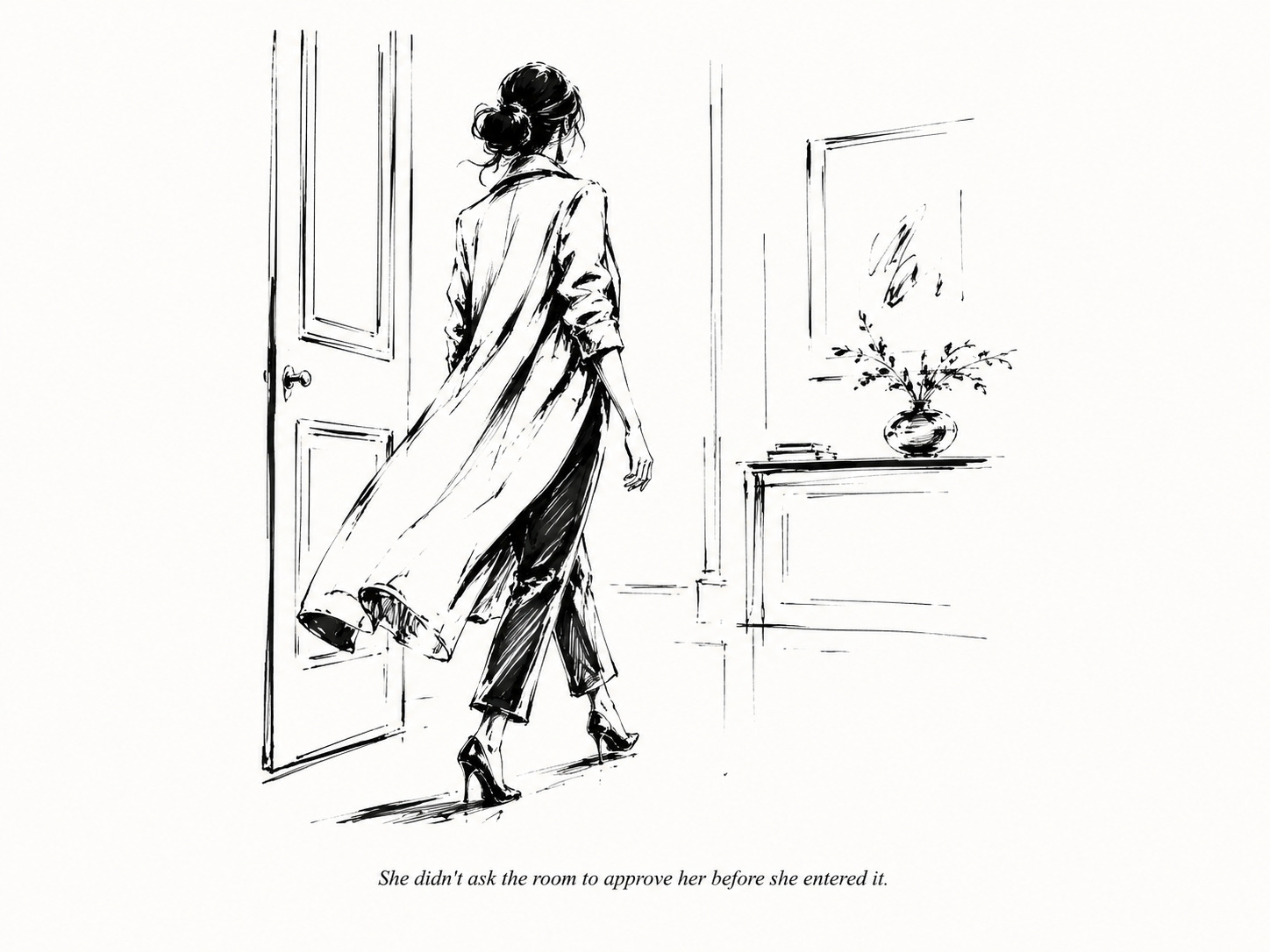
She stepped in and paused just past the threshold — just enough to actually look at the room instead of performing indifference to it. Coat off. Bag adjusted once. She picked her line through the space like she’d already decided. Greeted the host first, warmly and briefly. Then joined a conversation at the edge of the room rather than orbiting the bar waiting to be rescued.
Nothing remarkable happened. That’s entirely the point. She didn’t ask the room to approve her before she entered it, and so the room, in its way, did.
Performing confidence often looks like overtalking, overstyling, being too “on” — visible self-consciousness dressed up as charisma. Too much gesture. Too much explanation. Too much effort to prove every credential in the first five minutes. It’s exhausting to watch and exhausting to do.
Presence looks like a clean entry, a clear voice, a measured pace, listening that’s actually receptive, answers that don’t run long. Composure is confidence without the noise.
Presence is not perfection. It’s fewer leaks.
The goal isn’t flawlessness. It’s reducing unnecessary leakage — the small ways presence disappears before anyone notices it’s gone.
Leakage looks like apologizing too much, fussing with clothes, overexplaining, rushing answers, checking your phone at the wrong moment, carrying visible travel chaos, letting hunger or fatigue hijack your face, speaking before you’ve thought, filling silence because silence feels expensive. None of these are fatal on their own. All of them compound. And together they add up to a version of you that’s slightly less than the one who walked in prepared.
The invisible work people feel
Presence is preparation made visible.
What preparation actually means: knowing the room, knowing your role, knowing your first sentence. Knowing what you won’t get pulled into. Knowing what your body needs before and after. Knowing what you’re wearing and whether it works seated, standing, walking, and photographed. Knowing your recovery plan. Knowing when to be warm, when to be concise, and when to stop talking.
None of this is visible when it’s done well. That’s the point. The preparation disappears into the ease, and what remains is someone who seems, simply, ready. People feel that. They don’t always know what they’re feeling — but they feel it.
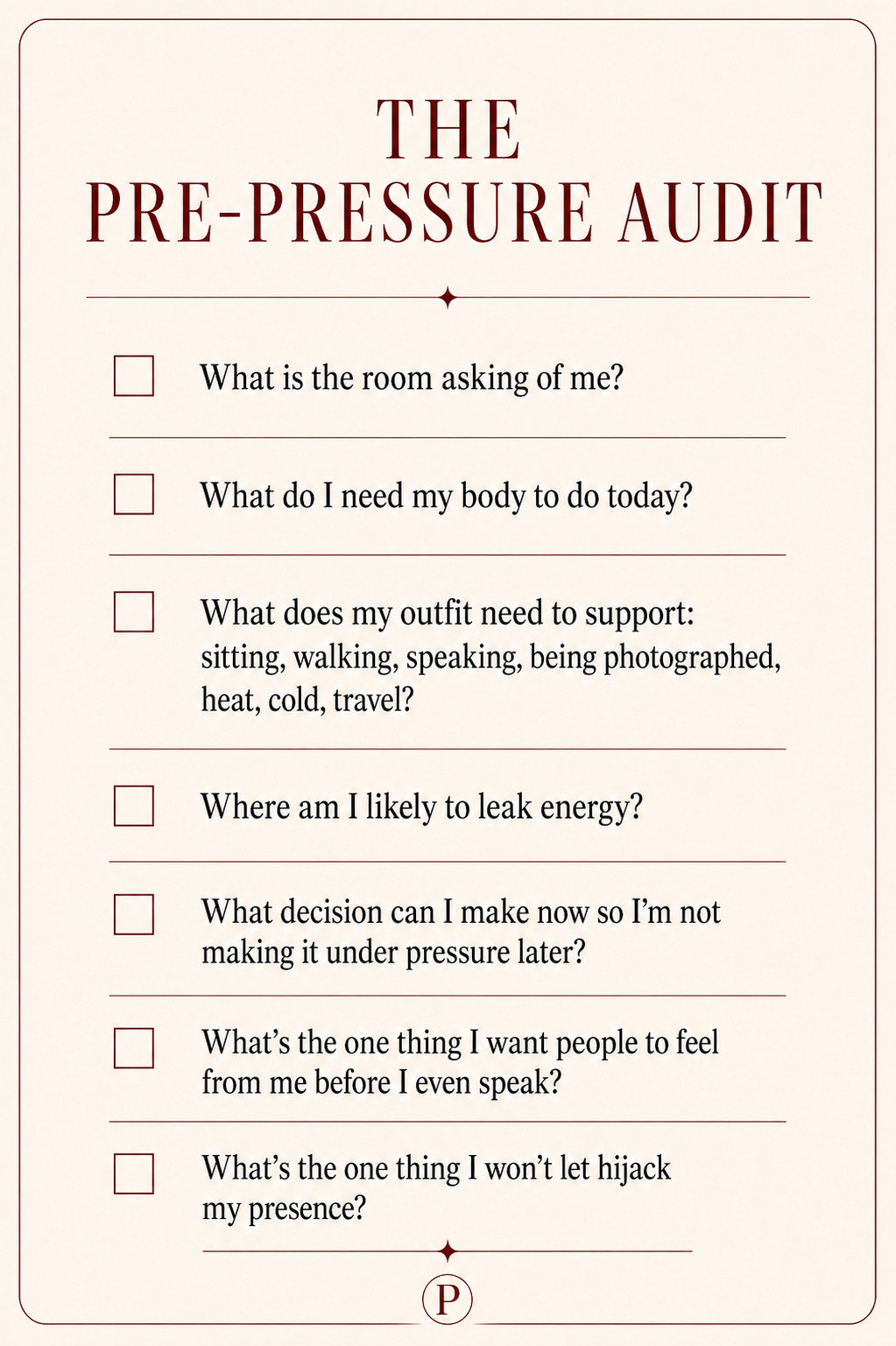
Before a high-pressure day, run this:
Looking polished isn’t the enemy. It’s a useful layer. But presence is what remains when the lighting changes, the schedule slips, the question gets harder, the room gets colder, and the day asks more of you than the outfit can answer.
Presence is preparation made visible.
And under pressure, preparation is what people feel.
— Mel
Polish gets noticed. Presence gets trusted.