
Public Speaking Without Performing
The best speakers don't perform. They communicate. The audience always knows which one they're watching.

I grew up performing. Cello, piano, competitive figure skating, Kuk Sool Won — disciplines where you show up in front of people and execute something you’ve practiced until it lives in your body. I was good at the skating despite a hilariously high center of gravity for the sport. Nearly six feet tall in an arena full of people built close to the ground. I competed regularly and managed to land my jumps well and take medals home.
But the moments I remember most from the ice weren’t the competitions. They were the exposition skates — not scored, not judged — that my sister and I would do together during competition events. My sister is disabled: developmentally delayed, on the spectrum, and with mobility challenges. Which meant the two of us on the ice together wasn’t a technical showcase. It was something else entirely: two sisters and best friends, working to create something beautiful and joyful to share with everyone. Including ourselves.
Nobody was scoring us. Nobody was waiting for us to fall. The only thing that mattered was the thing itself — and whether the people watching felt something.
Those skates taught me more about public speaking than anything else has. When the judges weren’t scoring, something truer took over. The audience felt the difference. I felt the difference. And I’ve been chasing that quality ever since.
The audience doesn’t need you to be perfect. They need you to be present. They need to feel that you’re with them — not trapped inside your own performance.
The performance trap
Public speaking isn't only keynotes and panels. It's the client presentation, the all-hands, the moment someone turns to you at dinner and says "tell them what you told me." Any time you're speaking and someone is listening with intention, the same principles apply.
Most people preparing to speak in public make the same mistake: they try to become a great speaker instead of a clear person in front of other people. They rehearse the sentences. They polish the transitions. They practice the gestures. And then they get up in front of a room and deliver something technically proficient that leaves almost no impression — because what the audience received was a performance, not a person.
Over-rehearsed is its own kind of unprepared. You can hear it: the voice that’s memorized the words rather than owned the ideas, the pause that happens on schedule rather than because a thought needed to land, the recovery from an interruption that sounds like someone’s lost their place in a script. The audience can’t always name what they’re feeling but they feel it. The word they reach for, usually, is “polished.” Which sounds like a compliment and isn’t quite one.
The opposite of performing isn’t being unprepared. It’s being prepared enough to be free. Knowing the material so thoroughly that you can leave the script behind and actually be in the room — reading it, responding to it, letting the thought arrive in the moment rather than reciting it from memory.
How to prepare without over-rehearsing
My preparation isn’t about memorizing. It’s about removing variables.
Before I speak anywhere that matters, I want to know three things: what the room needs from me, what the one idea is that I can’t leave unsaid, and where I can create space instead of rushing to fill it. Those three answers give me the architecture. Everything else is improvisation within a structure I trust.
For panels specifically, I map the arc: what I’m likely to be asked, where I want to enter the conversation, what proof points I need in my body, what I can safely leave alone. I resist writing full answers unless the moment genuinely requires precision. Full scripts make people chase the sentence instead of communicate the thought — and the audience can hear that chase happening in real time.
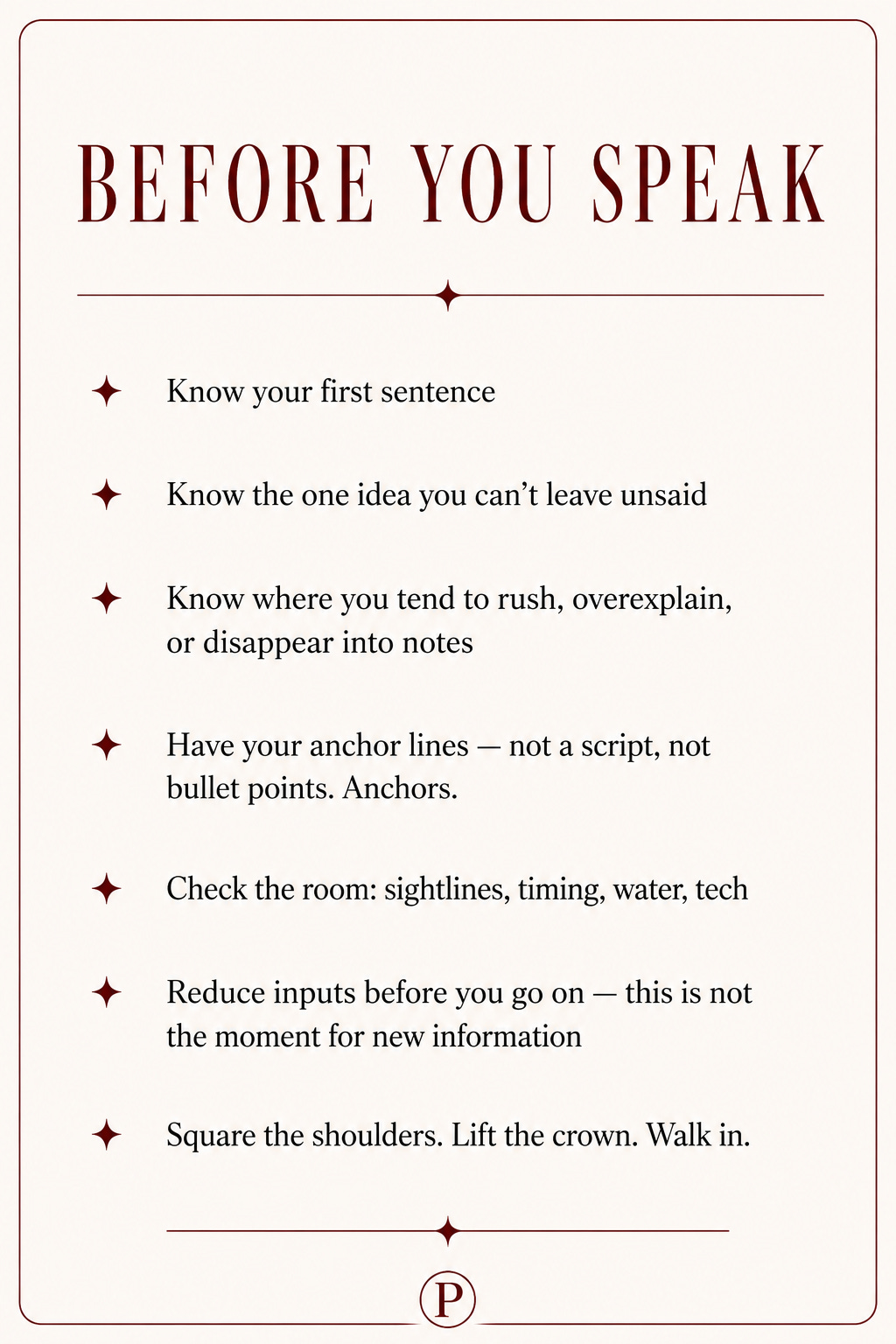
Instead: a few anchor lines, a few facts, and the first sentence. The first sentence matters more than people think — it gives your body a place to land. After that, I want enough preparation to be sharp and enough freedom to be alive.
The day of, if it’s remotely possible, I get quiet. Reduce inputs. Check the outfit, the water, the notes, the room timing, the sightlines. I don’t want to be solving logistics when I should be regulating my nervous system. Preparation isn’t about controlling everything. It’s about making sure the avoidable chaos has already been handled.
The first sentence
Know it before you walk in. Not as a line you recite but as a place you arrive. The first sentence isn’t your introduction. It’s the room’s first evidence of what kind of speaker you are.
A first sentence that starts with “So, um, I was asked to talk about...” is already behind. A first sentence that starts with a specific, declarative, confident claim — even a short one — has already told the room something. The body follows the opening. Start grounded, stay grounded. Start scattered, spend the next five minutes clawing back.
Write it a few days before. Say it out loud the night before until it sounds like you. Then let it go and trust that it’ll be there when you need it.
What to do with your body
The body is always speaking. The question is whether it’s saying what you want it to say.
Pace. Slower than feels natural. Almost always. The instinct under pressure is to speed up — to fill the air, to get through it, to outrun the anxiety. The audience experiences that speed as nervousness even when the words are good. Slow down deliberately and the room reads it as confidence.
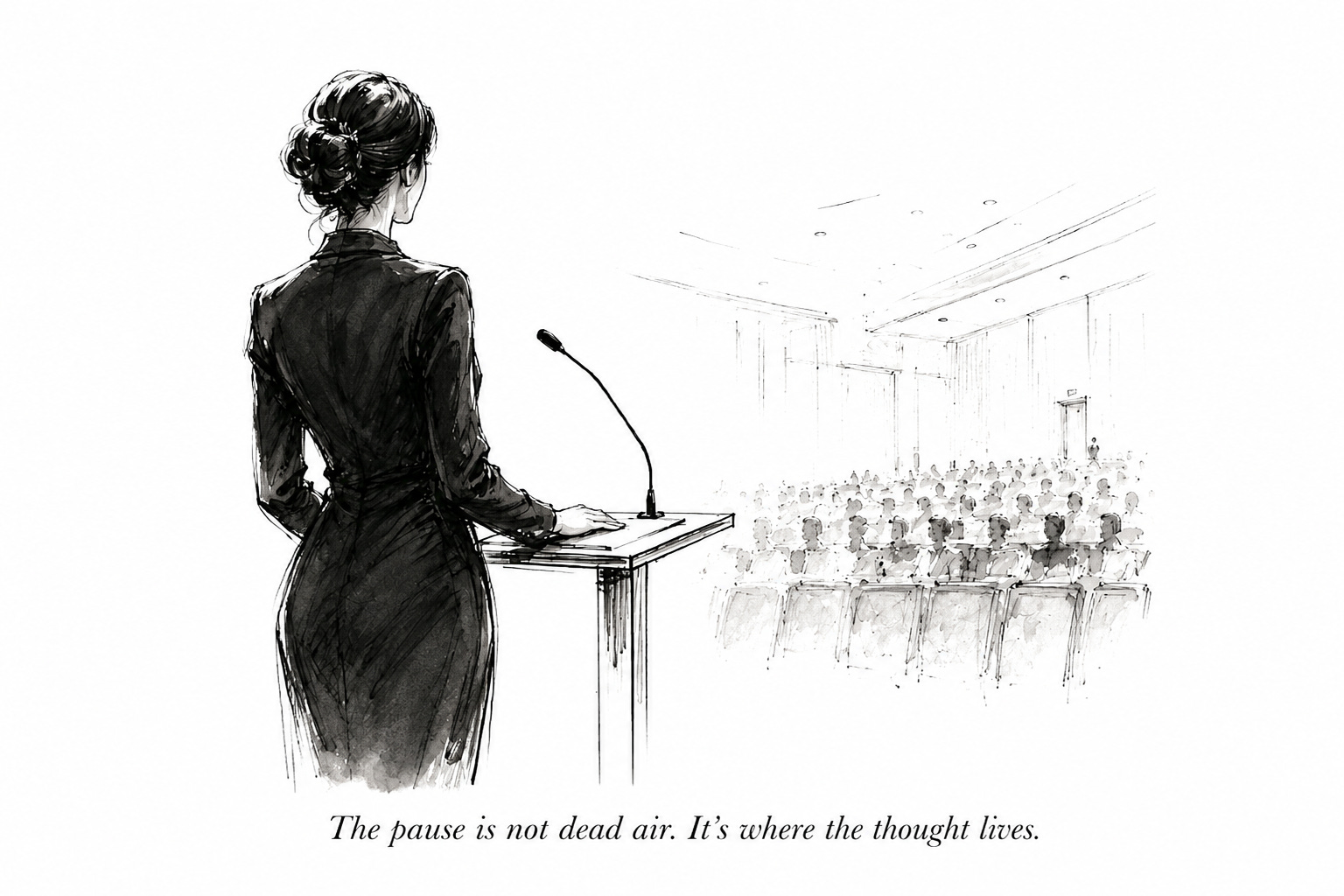
The pause. Not dead air. Where the thought lives. The best speakers use silence the way good musicians use rests — not as emptiness but as punctuation, as emphasis, as the space that makes what came before it land. A thought delivered without a pause after it is a thought the audience has to chase. A pause says: that was worth sitting with.
Gesture. Purposeful or still. The middle state — small, fidgety, repetitive movement — is the one that costs you. Hands that are always moving give the audience something to watch that isn’t your face or your words. Still hands when you’re not gesturing, deliberate movement when you are.
Posture. The spine is a presence signal. Shoulders back, crown up, weight grounded. The same sequence that works before you walk into a room works at the podium. You’re not standing. You’re occupying space.
The hardest room
The hardest speaking situations aren’t always the biggest rooms. Sometimes they’re the rooms where everyone is polite, skeptical, and waiting to see whether you actually know what you’re talking about. A hostile room can be useful — at least the energy is visible. The harder room is the one where the resistance is quiet: crossed arms, careful faces, people who’ve heard the polished version before and are listening for whether there’s substance underneath it.
In those rooms, performance fails quickly. You can’t charm your way through a hard question from someone who understands the material. You have to slow down, answer the actual question, and resist the urge to prove too much. The move is to stay in command of yourself.
But the hardest speaking engagement of my life, by a significant margin, was officiating a wedding for the first time. Not a keynote or a panel. A wedding — under fifty people, intimate, the most meaningful day in the lives of several people in that room. I was setting the tone for all of it. Responsible for the joy, the ceremony, the lightness, and the love — things I genuinely felt, but was being asked to transmit to a room while standing completely still in the spotlight, which is firmly outside my comfort zone.
I’m an introvert. My comfort zone has always been behind an instrument or in motion — the cello, the ice, the mat. Or ideally, just behind the curtain, full stop. Picturing everyone in their underwear was not going to cut it. What I needed was to divorce myself from my nerves (pun genuinely not intended, given the occasion) and anchor in what I knew I needed to deliver. Not my feelings about being watched. Their experience of being held.
That shift — from managing your own experience to serving the room’s — is everything. In a wedding, in a board presentation, in a panel where someone is gunning for you. The stakes change. The move doesn’t. The moment you stop performing for yourself and start communicating for them, something changes. The audience feels it before they can name it.
Handling hard questions
Take the pause. Let the question finish — fully, without beginning to formulate your answer while they’re still talking. Don’t grab at the first answer because silence feels expensive. If the question is pointed, don’t become pointed back. Answer with clarity, not temperature.
Hard questions tend to fall into four categories, and knowing which one you’re in changes how you respond. The genuinely difficult question — where you don’t have a complete answer — deserves honesty about what you know, what you don’t, and where the real uncertainty lives. The hostile question deserves composure and directness, not defensiveness. The trap question — designed to get you to confirm a negative frame — should never be answered on its own terms. Name the frame, redirect to your actual point. The personal question that crosses a line deserves a warm, firm boundary: “That’s not something I’ll speak to here, but what I can tell you is...”
The composure is the answer. Before you’ve said a word in response, the room is reading how you received the question. Unruffled is already a position.
Recovering from a stumble
Do less. That’s it.
Don’t apologize five times. Don’t narrate your nerves. Don’t make the audience take care of you by visibly catastrophizing a moment that, to most of them, was barely noticeable. The stumble becomes significant only when you make it significant. Correct, breathe, continue. The audience will follow your lead on how much it mattered. Give them nothing to follow.
The speakers who recover best from stumbles are the ones who’ve stopped trying to be perfect in the first place. When perfection isn’t the goal, an imperfection is just a moment — not an indictment.
The real goal isn’t applause. It’s trust. An audience that trusts you will follow you anywhere — through the stumble, through the hard question, through the moment where you pause and let the silence do its work. An audience that’s watching a performance will politely applaud and forget you by the time they reach the subway.
Be the person on the ice who isn’t skating for the judges. Be in the room for the people in it.
— Mel
The real goal isn’t applause. It’s trust.