
The Packing System
Not what to bring. What needs to be possible when you arrive.

I used to pack the way most people pack: starting too late, asking the wrong question, and ending up at the airport with seven tops, the dress I don’t actually like, and a pair of heels that only work with one specific outfit and a very specific version of my mood. This isn’t preparation. This is fabric-based anxiety with a luggage tag.
The wrong question is: what might I need? That question has no bottom. The honest answer is anything, depending on what happens, and since you can’t control what happens, you’d better bring everything — which is how you end up checking a bag the size of a small European country for a four-day trip and still feeling underprepared when you get there.
The better question is: what needs to be possible when I arrive?
For a real trip, the answer might look like: I need to look credible in meetings. I need to go straight to dinner from the conference. I need to survive an over-air-conditioned ballroom. I need one look that can escalate if plans get exciting. I need to not hate myself getting dressed at 7:12am in hotel lighting.
That’s not a packing list. That’s a brief. And packing from a brief looks completely different from packing from anxiety.
Packing well isn’t about being low-maintenance; it’s about being high-control.
On checking bags
Let’s get this out of the way. Sometimes you check a bag, and that’s correct. Gowns, black tie, press moments, multiple formal dinners, glam tools — these are real constraints that we navigate as real high-visibility women, and carry-on only isn’t always the answer. Anyone who tells you otherwise has never attended a gala in a city that isn’t home.
The distinction that matters: check a bag because the itinerary requires it, not because your anxiety packed for you. A larger bag isn’t permission to stop editing. It’s just more room to make the same decisions better. The edit gets more important, not less, when the suitcase gets bigger.
The five roles every bag needs to fill
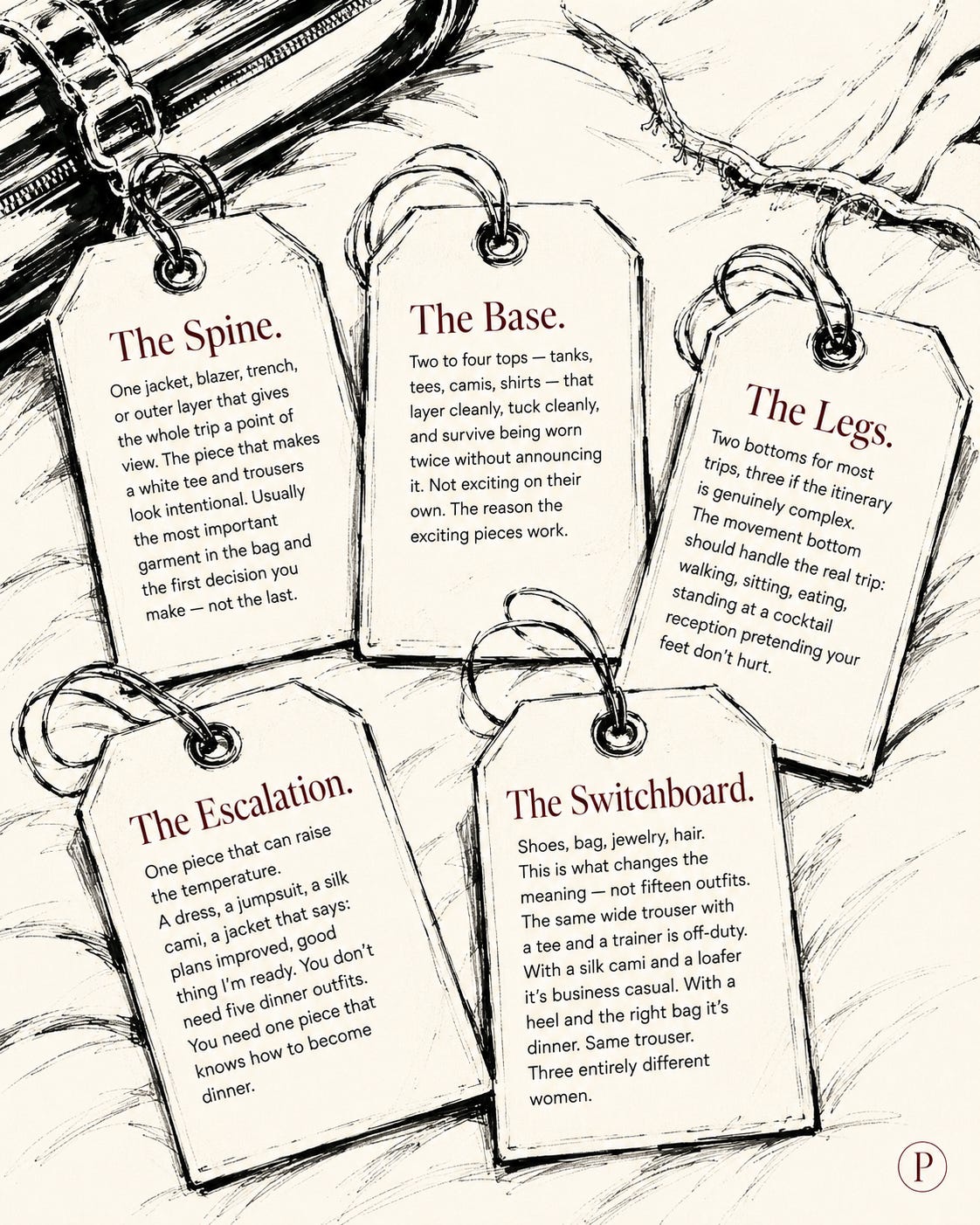
Every trip — four days, fourteen days, three days of meetings followed by two days of pretending you’re on vacation — needs the same architecture. Not five outfits. Five roles. Think of it as casting, not shopping.
Interoperability is the whole game
The amateur packs outfits. The professional packs relationships.
Every item should speak to at least two other items in the bag. Ideally three. A good travel wardrobe isn’t Monday outfit, Tuesday outfit, Wednesday outfit, dinner outfit, backup outfit, and the emotional support outfit you pack every single time and never wear. It’s a cast of characters with assigned roles who can improvise when the script changes. The goal isn’t to bring everything you might need. It’s to bring nothing you’ll have to think about.
Shoes are where we lose the bag
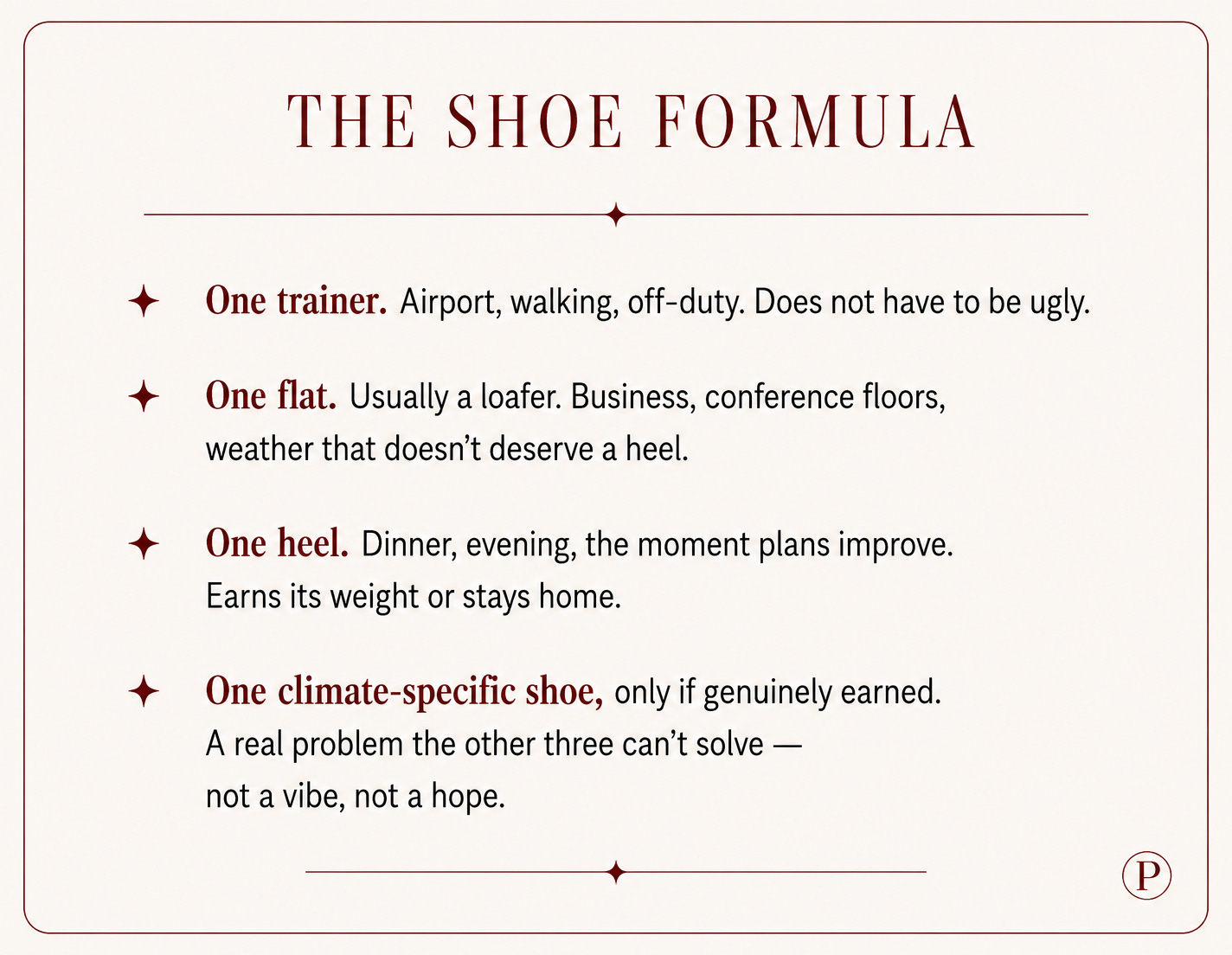
Shoes are not accessories in a suitcase. They are real estate. And most of us are paying too much rent.
The fantasy shoe list: a walking shoe, a dinner shoe, a business shoe, a backup shoe, a sandal, the fun shoe, and the one that only works with one dress and a very specific version of your mood. That’s not a shoe collection. That’s a suitcase held hostage.
Bags need jobs, not moods
We pack bags emotionally. This is where the chaos starts and the tote collection gets quietly out of control.
A bag without a job is a beautiful inconvenience. Every bag on the trip should be able to answer: what specifically do you solve? The daybag handles the laptop, the chargers, the emergency face. The crossbody handles the airport, the market, anything requiring two free hands and a low profile. The evening bag earns its place only if the trip has real evening moments — and only if it changes the reading of something already coming.
Worth noting: the bag does more work than people credit it for. The same dress with a structured tote says work. With a tiny clutch it says plans. With a crossbody it says range. The bag is the edit.
The four-day formula
Work trip, dinners, off-duty time. Here’s what actually comes:
On the plane: trainer, travel bottom, tee or tank, the Spine layer, daybag or crossbody. The plane outfit is part of the capsule. If it can’t be worn again, reconsider bringing it.
In the bag: one business trouser, one second bottom, one escalation piece, three tops, one blazer or jacket, one flat, one heel, one daybag, one evening bag if the itinerary earns it, and jewelry that changes tone without taking space.
Between those two — what you’re wearing and what’s packed — you have: the airport, two or three work looks, one dinner, one casual drink, one off-duty morning, and one “plans changed” moment. There’s your whole trip.
What I stopped bringing
Fantasy outfits. The ones that only work if I’m not bloated, the weather behaves, the lighting is kind, and the plan becomes more glamorous than promised. If an outfit requires a better version of the day than I can reasonably expect, it doesn’t get packed.
Duplicate black tops. One good black base layer beats four “maybe” tops. Be honest with yourself: the “maybe” tops aren’t hedging, they’re hoarding.
The emergency dress. If it has saved me zero times across fifteen trips, it is not an emergency item. It’s fabric-based anxiety wearing a sundress.
Fragile pieces. If a garment can’t survive a suitcase, a dinner chair, and a weird hotel closet, it needs a compelling reason to come. Compelling reasons include: it is the entire point of the trip. That’s about it.
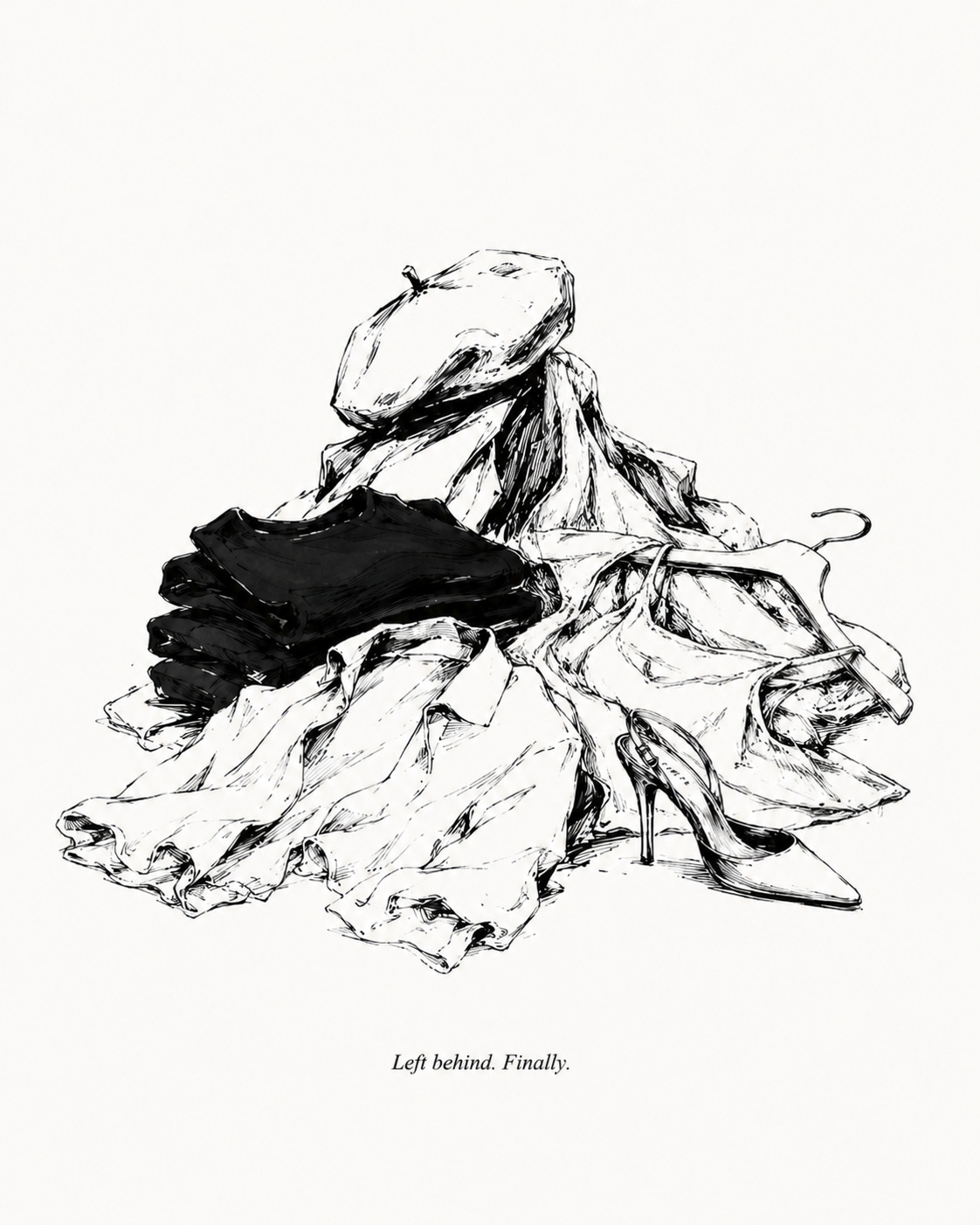
Destination cosplay. You don’t need to dress like the place. You need to dress like yourself, appropriately translated. Nobody needs a beret in Paris. Paris does not require this of you.
The one thing most of us pack wrong
We pack for scenarios instead of silhouettes.
The thinking goes: what if there’s a dinner? What if somewhere nicer? What if it’s cold? What if I need another option? A different outfit gets packed for every anxiety, and the bag ends up full of contingencies and light on actual range.
A new event rarely requires a new outfit. It usually requires a different shoe, a different bag, different jewelry, hair up instead of down, jacket on instead of off. You don’t need more clothes. You need more versatile ones.
I stopped packing for fantasy versions of the trip. I pack for the woman who has to get dressed at 7:12am in hotel lighting and still walk out looking like she meant it.
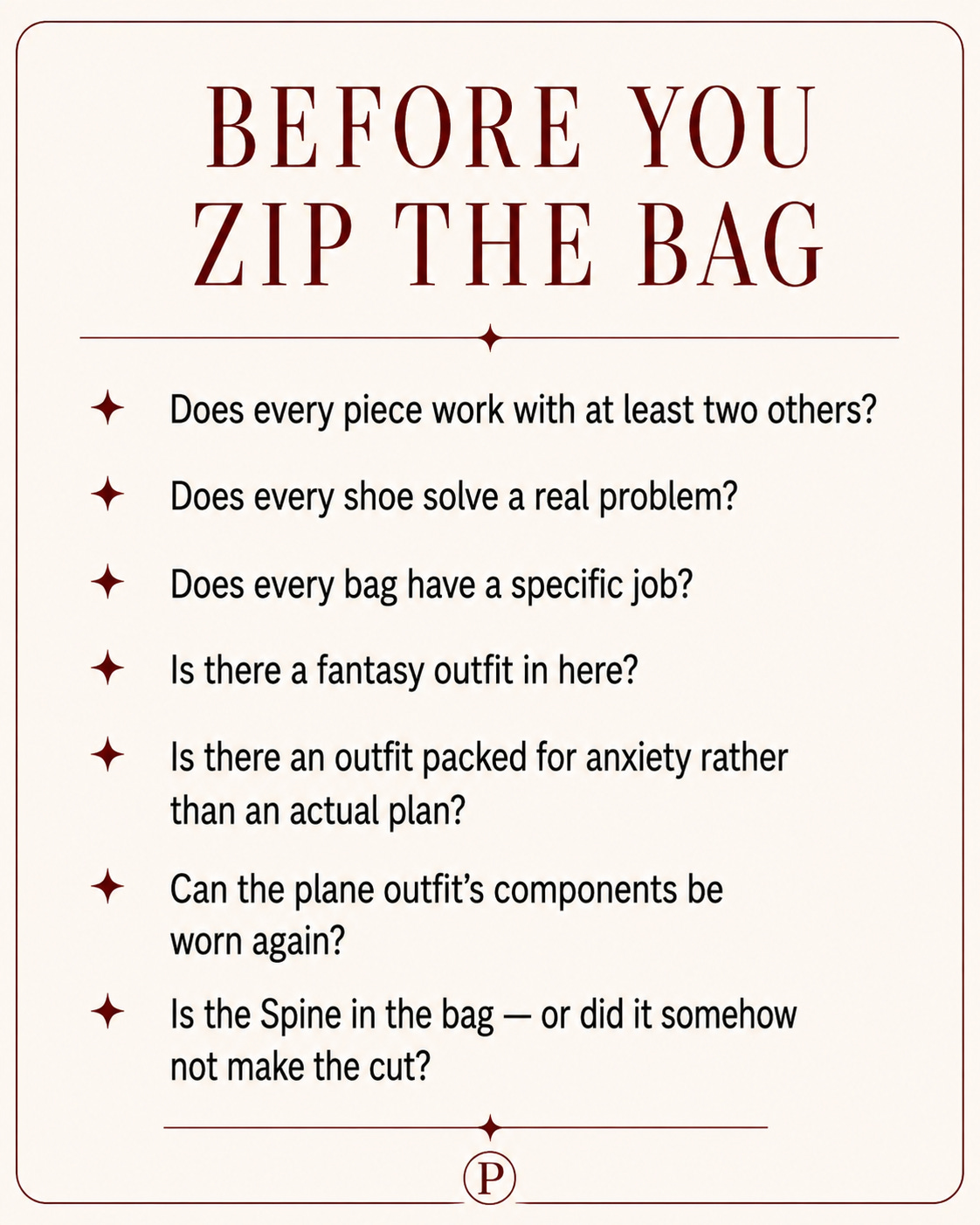
A packing list is just an anxiety management tool with better branding. The goal is to make the decisions in advance, at home, in good light, so that by the time you’re at the airport you’re not negotiating with yourself. You’re just moving.
Packing isn’t about bringing less. It’s about arriving with fewer decisions between you and the woman you came there to be.
— Mel
The suitcase is not the place to negotiate with your fantasy self.