
The Panel Prep Framework
The goal isn't to sound prepared. It's to sound like yourself, but better organized.

My boyfriend called me after his panel. I could hear him grinning.
A bit about why I knew he’d be good at public speaking: he’s one of the clearest thinkers I know, and clarity is most of what a panel actually rewards. The credentials are real — Ivy League, multiple successful businesses, effortlessly magnetic. But the reason I wasn’t worried is that he can make a hard idea land in a sentence. He just hadn’t done it onstage since college.
I loved the contrast from the night before the panel, when he was somewhere between calm and Oh Shit — the particular combination that happens when someone who is extraordinarily good at many things is about to do one thing they haven’t done in a while.
As he recounted the experience to me from the car, it was evident that he was locked in. Confident. He’d enjoyed it. He rode that high for the rest of the day.
He’d done exactly what he was always going to do. We just cleared the path the night before.
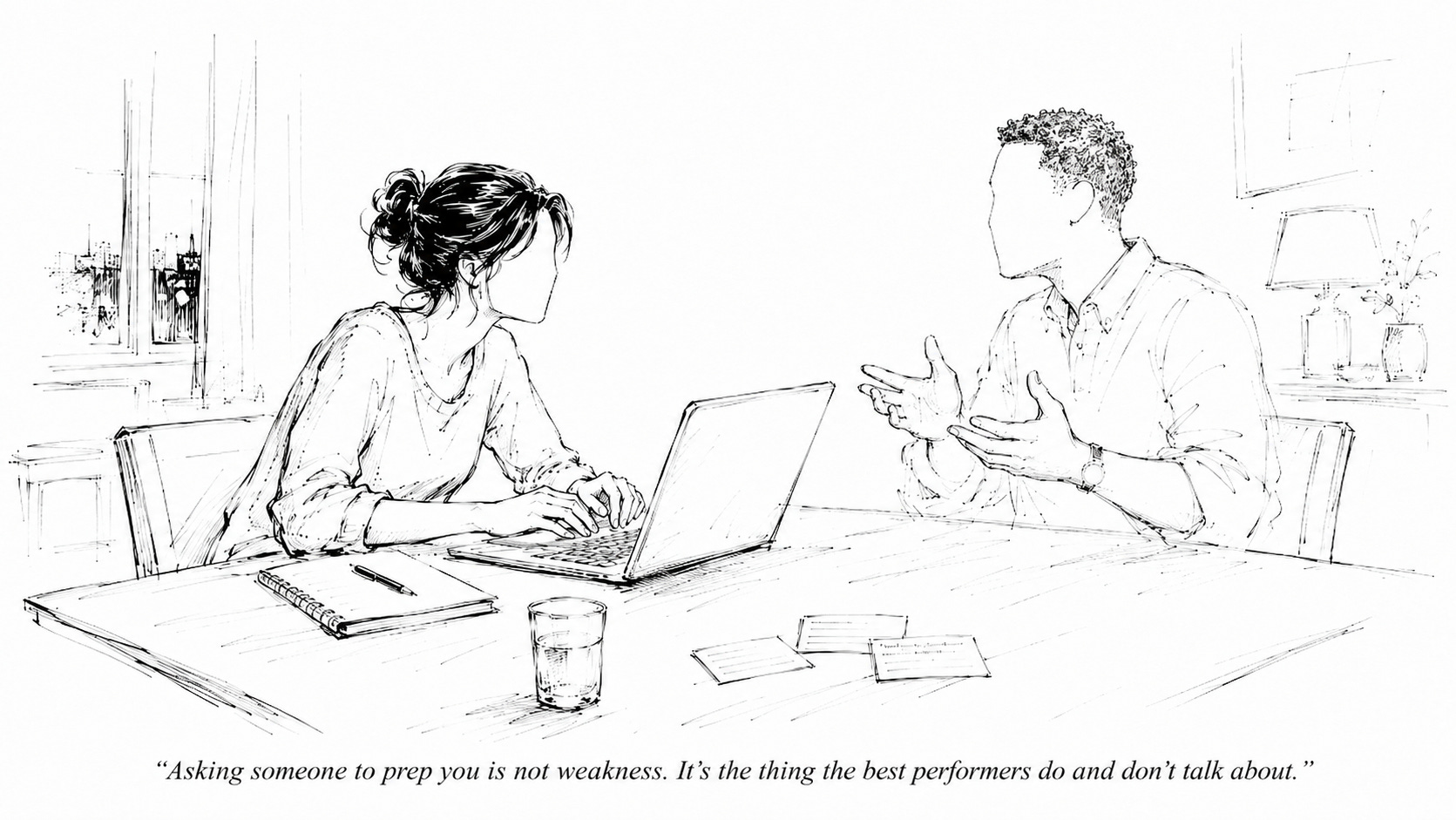
Here’s what we didn’t do: read through the moderator’s prep doc and rehearse answers. We scanned it, put it aside, and spent twenty minutes finding stories instead. I asked questions, he talked, I typed what landed. He put the talking points on flashcards. Took them onstage as a security blanket. Didn’t need them.
The preparation wasn’t about what he knew. It was about helping him locate what he already had.
Why most panel prep fails
The standard approach to panel prep looks like this: read the questions, draft answers, practice the answers, try to memorize enough of the answers that they sound natural under pressure. The logic is sound. The result is usually someone who sounds like they’ve been coached — not because they have been, but because the thing they’re trying to do is fundamentally at odds with what the audience wants.
Audiences don’t want the polished version. They want the person. They can feel the difference, and they make that determination within the first thirty seconds of someone speaking. Memorized answers have a texture that live, arrived-at answers don’t. The search for the right word, the real pause, the moment someone remembers something concrete — these read as presence. The rehearsed version of the same content reads as performance, even when the content is excellent.
Over-preparation is a form of self-protection that looks like diligence. The thing it protects against is the risk of being genuinely yourself in the room. The thing it costs is the version of you the room actually came to see.
What good prep actually looks like
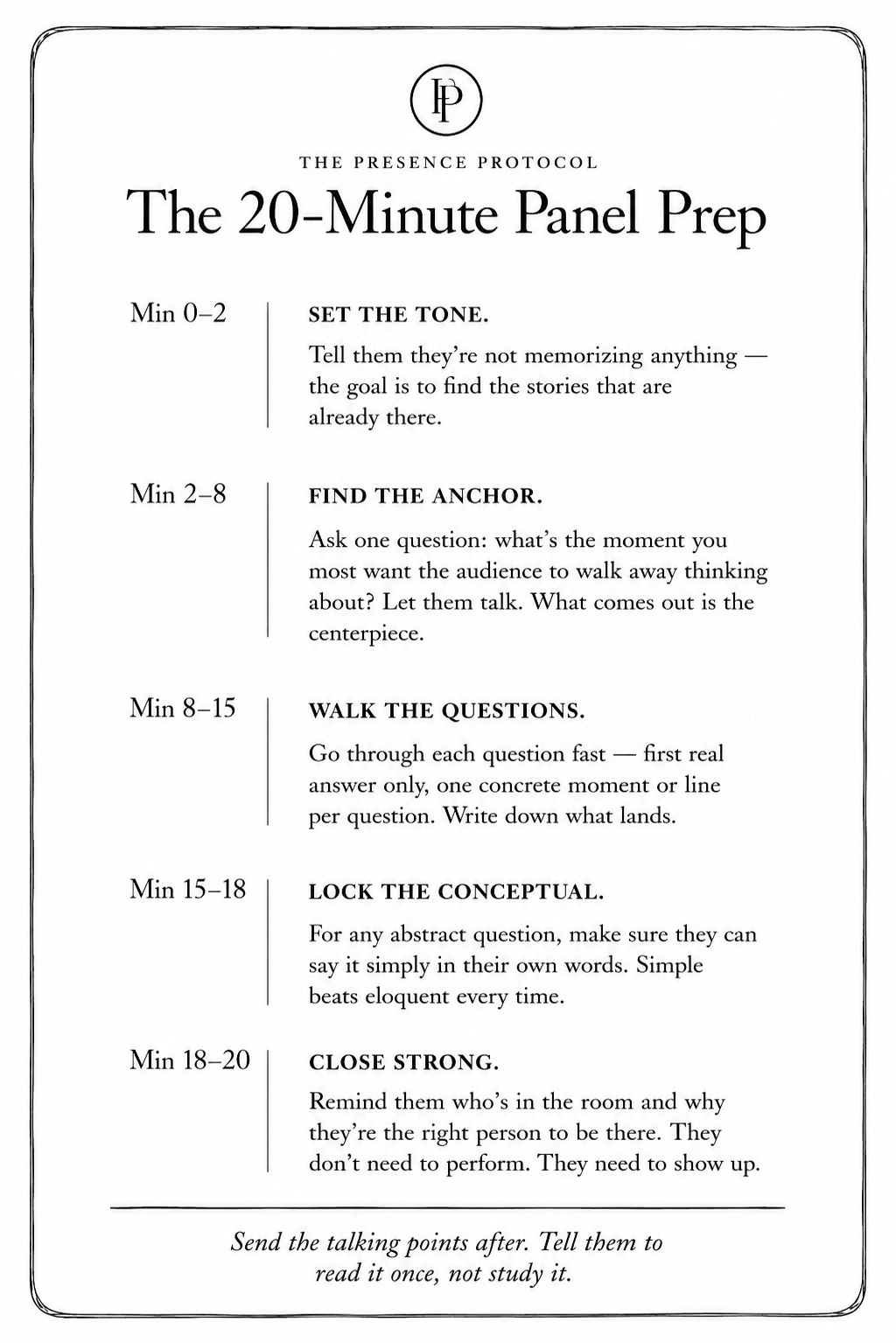
Twenty minutes. One question to start: What’s the moment you most want the audience to walk away thinking about?
Let the answer run. Don’t interrupt. What comes out of that question is almost always the centerpiece — the story or the position that everything else in the panel can orbit around. Once you find it, name it. Tell them: that’s your anchor. Everything else builds around it.
Then move through the panel questions fast, one by one. For each one, ask only: What’s the first real thing that comes to mind? Not the best answer. Not the complete answer. The first real one. What you’re looking for is one concrete moment or line per question — the thing that’s already there, that doesn’t need to be built from scratch. Jot down what lands. Skip what doesn’t.
If any questions are more conceptual — explaining a trend, framing a position — spend a beat making sure they can say it simply in their own words. Not eloquently. Simply. The room can follow simple. The room gets lost in eloquent.
Then close with the thing most prep sessions skip entirely: remind them who’s in the room and why they’re the right person to be there. Not as a pep talk. As a reorientation. They don’t need to perform. They need to show up as themselves, which is a different instruction than it sounds.
The talking points
After the session: write up what landed. Not a script — a document with the anchor story at the top, the strongest line or moment from each question below it, and nothing else. Send it over. Tell them to read it once, not study it.
The talking points are a safety net. You build them so you don’t need them. What they actually do is give the person permission to stop preparing — to trust that the work is done and go to sleep. The subconscious does the rest. By the time they’re onstage, the material has settled in without the artificial rigidity that comes from actual memorization.
The flashcards are the same idea in physical form. Taking them onstage is fine. Using them is optional. Having them in hand is the real function — a security object for someone who has more than enough material and just needs to know it’s there.
The talking points exist so you can stop thinking about the talking points.
Who to ask
This framework works two ways: you can run it on someone you’re prepping, or you can hand it to someone who knows you well and ask them to run it on you. The second version is the one most people never think to do.
The person running it can’t be a yes-person. They’ll confirm everything and push back on nothing, and you’ll walk into the panel with your worst instincts polished rather than your best ones surfaced. They also can’t be a professional coach you’ve just met — not because coaches aren’t good at this, but because story-finding requires someone who already knows how you think, what you sound like when you’re actually saying something real versus when you’re performing a version of yourself you think is expected.
What you’re looking for is someone who knows you well enough to say “that’s not you” — and who will say it. A colleague you trust. A friend who’s seen you in rooms. A partner who’s heard you tell the same story six times and knows which version is the one that lands.
I’ve done the solo version when the right person wasn’t available — talking through stories out loud before a panel, no audience, just me and a quiet room. It works, with diminishing returns. The thing a second person provides that a quiet room can’t is the moment of recognition: the slight lean forward, the pause, the “say that again” that tells you something real just came out. You can approximate it alone. You can’t replicate it.
The morning of
Stop preparing. This is the instruction most people are least equipped to follow.
The morning of a panel is for execution, not preparation. If the work was done the night before — and it was, in twenty minutes — then the morning is for sleep, a real breakfast, whatever movement your body needs, and showing up intact. Any additional preparation at this stage introduces new information the nervous system doesn’t have time to integrate, and destabilizes what’s already settled.
Read the talking points once if it makes you feel better. Once. Then put them away.
The thing that’s true about every panel, every keynote, every room with a microphone: the version of you that shows up is the version that was there all along. The prep doesn’t create that version. It just gives it permission to be the one that walks onstage.
— Mel
The room came for the person. Not the prep.